
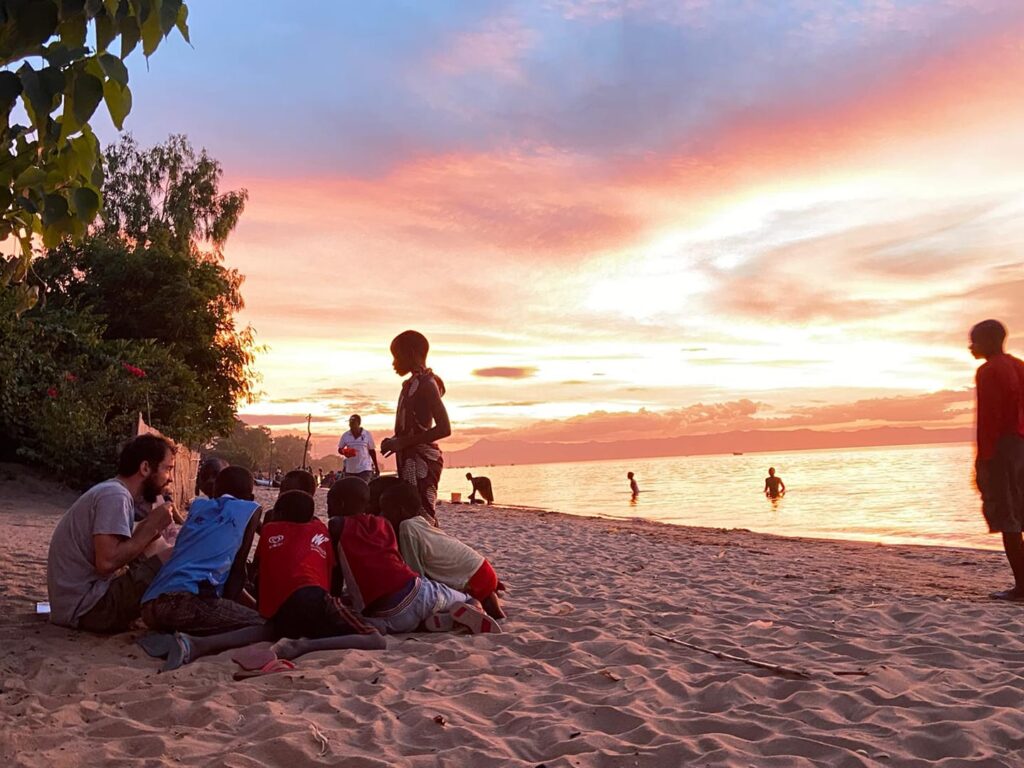
How it started..
In 2019, following Cyclone Idai, which affected more than 500,000 Malawians, Evin Joyce visited remote islands across Southern Malawi, including Chisi Island, as part of a UN recovery operation.
Hunger, unaffordable access to healthcare and an absence of schools were the most common complaints across the communities he visited. With similar uniformity, one community asset stood out: local women running outdoor preschools, with almost no support.
When Evin asked his sister, Ailbhe, a trained primary school teacher “What could support these preschool teachers right now, at very low cost?” School in an Envelope was born.
School in an envelope
Ailbhe arrived in Malawi in 2020 to design, test and distribute sets of low-cost, laminated flashcards to help these untrained preschool teachers improve early literacy and numeracy. As well the physical sets of flashcards, Ailbhe’s aim was to develop and document the minimum amount of the most effective training these women needed to use the flashcards optimally and show women in other communities how to use them so that the project could grow.
COVID-19, ‘Masks for Malawi’ & the ‘Lifesavers Club’
Covid-19 derailed the ‘School in an Envelope’ project as preschools were ordered to close. Communities’ priorities shifted to protecting their vulnerable and elderly. People needed masks and soap, and food to help those infected isolate at home without suffering from hunger. Evin and Ailbhe’s family in Ireland launched a GoFundMe page named Masks4Malawi that quickly received more than €20,000 in donations plus a grant of €7,500 from Ireland’s Embassy to Malawi. Working with the same preschool teachers, village chiefs, out-of-school children, and staff from local clinics, and a missionary priest from Donegal based in Malawi since 1981, the Lifesavers Club was formed and distributed more than 50,000 locally-made masks and bars of soap, and supported dozens of Covid patients self-isolating with food packages across more than 120 villages in Zomba District.
Post-Covid pivot back to chronic challenges and Chisi Island
When Covid ended, the chronic challenges facing children’s health, education and nutrition persisted. Generous private donations continued to flow in, plus a grant of €8,000 from Irish National Teachers’ Organisation and €7,000 from the Meitheal diocese youth leadership programme.
Ailbhe recommenced testing the ‘School in an Envelope’ model with preschools on the mainland. Evin decided to move to Chisi Island with its population of around 4,000 people to attempt to develop a low-cost, sustainable, community-driven approach to improve children’s health, education and nutrition. Why do it on Chisi Island? Because the communities on the island are among the world’s poorest, most isolated and most vulnerable to climate change. If the UN’s mantra for the Sustainable Development Goals is to ‘serve the furthest behind first’ this meant the children of Chisi Island should be first in line. The island’s relatively static and isolated population enables detailed monitoring of the spending required to make improvements. The idea was that by rigorously monitoring costs and benefits, solutions developed on the island can be replicated and scaled-up elsewhere.
Chisi Island
Watch Evin’s 2022 video explaining the long-term vision and development goals for the island.
How it's going..
Here Evin shares an update on progress from March 2025.
In 2026, Ulemu.com started the year with a €20,000 from long-standing friend of the charity, Cathal O’Connor, director of Beldare Homes.